
You ordered a bra online, it arrived in two days, and the band digs into your ribs before lunch. Or the cups gape every time you lean forward. Sound familiar? In Pakistan’s growing online lingerie market where trying before buying isn’t an option getting your measurements right before you click “Add to Cart” is the difference between a confident purchase and an awkward return.
The real problem isn’t that women don’t care about fit. It’s that most of us were never actually taught how to measure bra size properly. We inherited a size from one purchase years ago and kept re-ordering it, even as our bodies changed. According to professional bra fitters and multiple fit studies conducted by brands like ThirdLove and Triumph, the majority of women are wearing a band too loose and a cup too small a combination that kills both comfort and support.
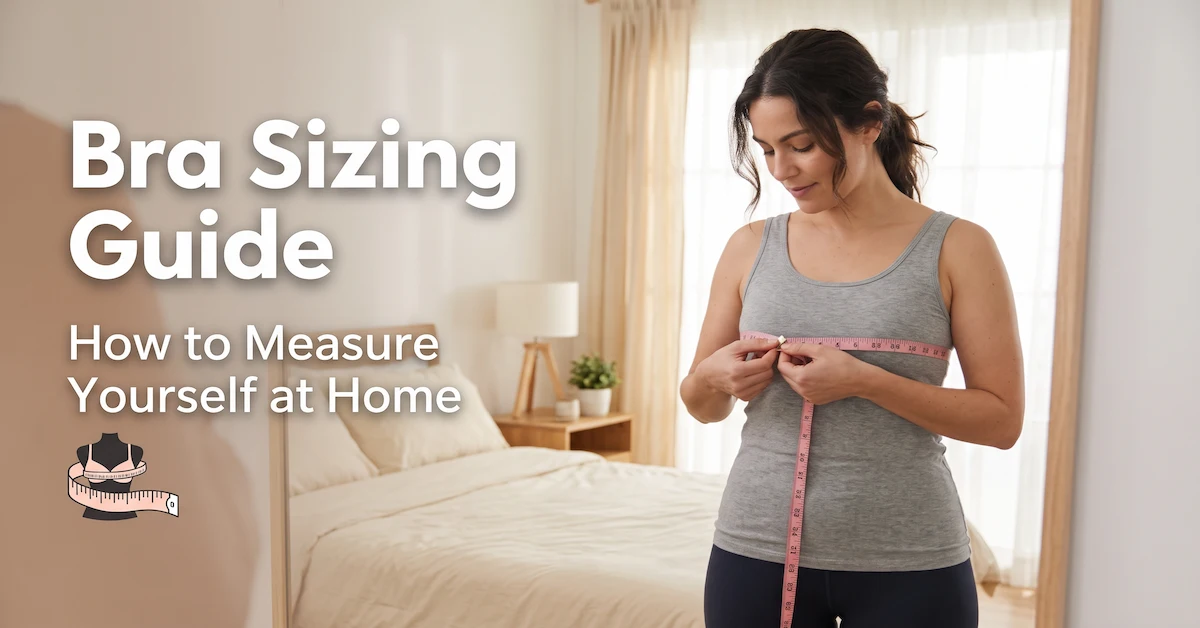
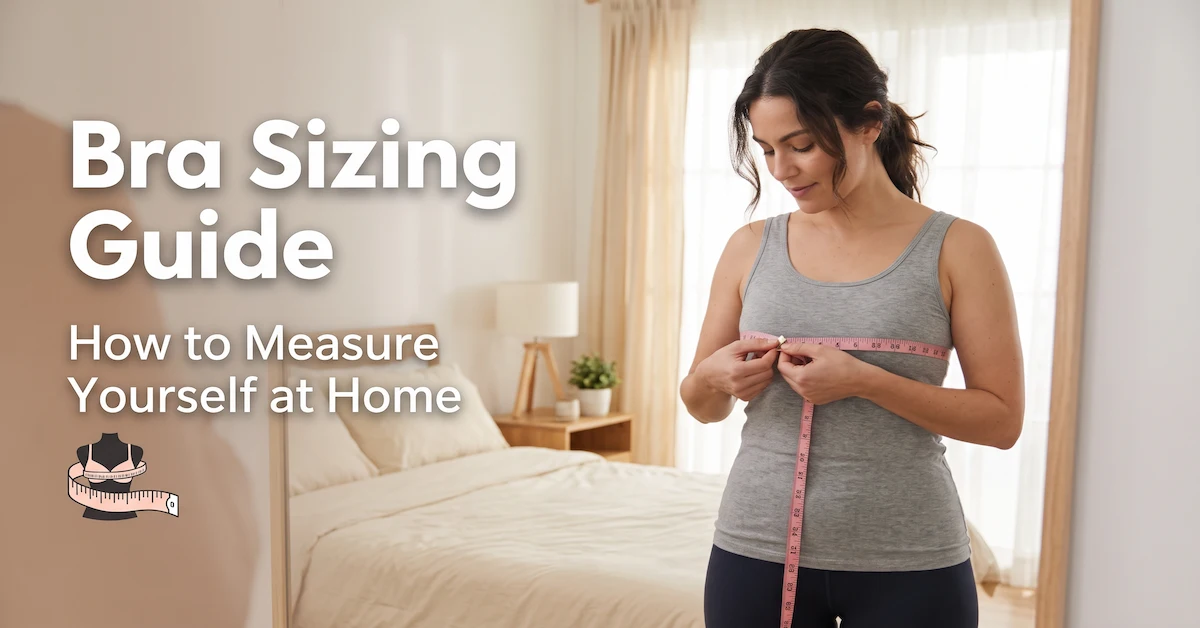
This guide gives you a reliable method to calculate your bra size at home using a flexible tape measure, a mirror, and about five minutes. No fitting room needed.
Why Accurate Bra Sizing Actually Matters
A well-fitted bra isn’t a luxury it’s functional engineering for your body. The band carries roughly 80% of the support load, not the straps. When the band fits correctly, it anchors firmly around your ribcage and distributes the weight of breast tissue evenly across your torso, reducing strain on your shoulders, neck, and upper back.
When the fit is off, the consequences show up quickly: the band rides up at the back because it’s too loose, straps dig into your shoulders because they’re overcompensating, cups overflow or wrinkle because they’re the wrong volume, and the centre gore (the small bridge of fabric or wire between the cups) lifts away from your sternum instead of lying flat. Lingerie fitting professionals refer to that last sign the gore not tacking flat against your chest as one of the clearest indicators of a poor fit.
Beyond comfort, correct sizing affects how your nightwear and everyday outfits sit on your frame. When your bra fits properly, necklines sit where they should, fabrics drape smoothly, and you move through the day without constantly adjusting.
What You’ll Need Before You Start
Three items make the process accurate:
A soft, flexible measuring tape the kind used for sewing or tailoring, not a rigid construction tape. If you don’t have one, wrap a piece of non-stretch string or ribbon around your body, mark where it meets, and measure the length flat against a ruler.
A non-padded bra padded, push-up, or moulded bras add volume that doesn’t reflect your actual bust size. Even light foam can add half an inch. A thin, unlined bralette or a soft-cup bra works well. If you only own padded styles, measure braless but keep your posture natural.
A mirror so you can check that the tape sits level and parallel to the floor all the way around. Even a slight tilt can shift your measurement by an inch or more.
How to Measure Bra Size at Home: Step-by-Step
Step 1: Measure Your Band Size (Underbust)
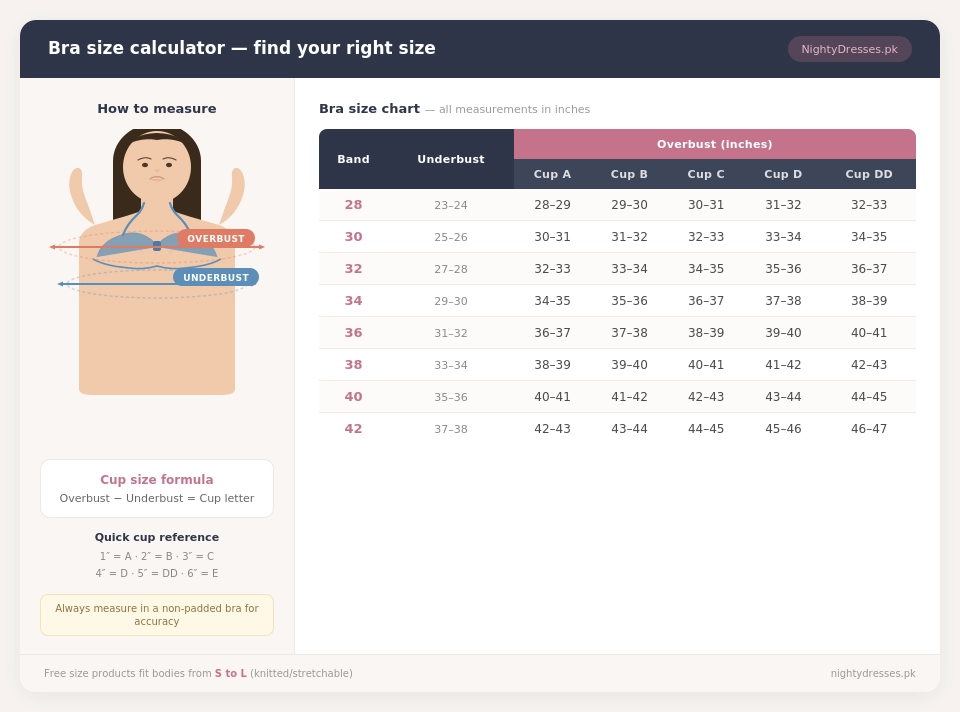
Stand straight with your arms relaxed at your sides. Wrap the measuring tape snugly around your ribcage, directly beneath your breasts — right where a bra band would sit. The tape should lie flat against your skin, firm enough that it won’t slide down but not so tight that it digs in or compresses the skin. Breathe normally and note the number in inches.
Rounding your measurement: If you get an even number (such as 30, 32, or 34), that number is your band size. If you get an odd number (like 29, 31, or 33), round up to the next even number. Some older sizing methods recommend adding 4 inches to an even reading or 5 inches to an odd one, but modern bras are constructed with elastane-blended fabrics that provide built-in stretch. Professional fitters now recommend using the raw rounded measurement for a firmer, more supportive fit — the band’s elasticity will provide the remaining give.
Example: If your underbust measures 31 inches, your band size is 32.
Step 2: Measure Your Bust (Overbust)
This measurement captures the fullest part of your chest. Wrap the tape around the widest point of your bust — typically across the nipple line. Keep the tape parallel to the floor, snug but not compressing breast tissue.
Don’t pull tight. The tape should lightly touch the surface of your skin without flattening anything. If it’s too loose, you’ll get a smaller cup result; too tight, and the calculation skews the other way.
Write this number down.
Step 3: Calculate Your Cup Size
Subtract your band measurement from your bust measurement. Each inch of difference corresponds to a cup letter:
| Difference (inches) | Cup Size |
|---|---|
| 0 | AA |
| 1 | A |
| 2 | B |
| 3 | C |
| 4 | D |
| 5 | DD / E |
| 6 | DDD / F |
| 7 | G |
| 8 | H |
| 9 | I |
| 10 | J |
| 11+ | K and above |
Example: Underbust is 32 inches, bust is 35 inches. The difference is 3 inches — your cup size is C, and your complete bra size is 32C.
Step 4: Put It All Together
Combine your band number and cup letter. If your band is 36 and your bust difference is 4 inches, you wear a 36D.
Once you know how to check bra size using this method, you can shop for padded bras, sports bras, or bra and panty sets with genuine confidence in your starting size.
Bra Size Chart: Quick Reference
Locate your band size in the left column, then read across to find the overbust range that matches your cup.
| Band Size | Underbust | Cup A | Cup B | Cup C | Cup D | Cup DD |
|---|---|---|---|---|---|---|
| 28 | 23–24″ | 28–29″ | 29–30″ | 30–31″ | 31–32″ | 32–33″ |
| 30 | 25–26″ | 30–31″ | 31–32″ | 32–33″ | 33–34″ | 34–35″ |
| 32 | 27–28″ | 32–33″ | 33–34″ | 34–35″ | 35–36″ | 36–37″ |
| 34 | 29–30″ | 34–35″ | 35–36″ | 36–37″ | 37–38″ | 38–39″ |
| 36 | 31–32″ | 36–37″ | 37–38″ | 38–39″ | 39–40″ | 40–41″ |
| 38 | 33–34″ | 38–39″ | 39–40″ | 40–41″ | 41–42″ | 42–43″ |
| 40 | 35–36″ | 40–41″ | 41–42″ | 42–43″ | 43–44″ | 44–45″ |
| 42 | 37–38″ | 42–43″ | 43–44″ | 44–45″ | 45–46″ | 46–47″ |
Free size products at NightyDresses.pk are made from knitted, stretchable material and fit bodies from S to L.
Understanding Sister Sizes
Sister sizes are bra sizes that share the same cup volume but pair it with different band and cup letter combinations. If you go up one band size, you go down one cup letter — and vice versa.
So a 34C, a 36B, and a 32D all hold roughly the same amount of breast tissue. The difference is how the band wraps around your torso.
This matters in two practical situations. First, if a bra in your measured size doesn’t feel right — say a 34C feels tight in the band but the cups are perfect — try the sister size 36B before abandoning the style entirely. Second, sister sizing is useful when shopping across brands, because band tension and elasticity vary between manufacturers. A brand that uses firmer elastic in its bands may feel tighter at the same number than a brand using softer, stretchier fabric.
| Your Size | Sister Size (Up) | Sister Size (Down) |
|---|---|---|
| 32C | 34B | 30D |
| 34B | 36A | 32C |
| 36D | 38C | 34DD |
| 38C | 40B | 36D |
US, UK, and EU Sizing: What’s the Difference?
If you’ve ever ordered a bra from an international brand and been confused by the size label, you’re not alone. The three major sizing systems — US, UK, and European — use different conventions, and the differences grow larger past a D cup.
US sizing uses letters that double up after D: DD, DDD, DDDD (or equivalently, E, F, G). UK sizing follows a cleaner alphabetical sequence: D, DD, E, F, FF, G, GG, H. European sizing replaces the band number with centimetre-based measurements (a US/UK 34 band = EU 75) and uses its own cup letter progression.
For most shoppers in Pakistan, the US system is the one you’ll encounter on local e-commerce stores, including NightyDresses.pk. However, if you order from international brands like Triumph, Marks & Spencer, or imported European labels, always check their specific conversion chart. A UK 34E and a US 34DDD are the same bra — but the label won’t tell you that unless you know to look.
| US Size | UK Equivalent | EU Equivalent |
|---|---|---|
| 34B | 34B | 75B |
| 34C | 34C | 75C |
| 34D | 34D | 75D |
| 34DD | 34DD | 75E |
| 34DDD | 34E | 75F |
| 34G | 34F | 75G |
How to Tell If Your Bra Fits Correctly
After measuring and purchasing, here are the signs of a proper fit that professional fitters check:
The band sits level and horizontal around your torso, parallel to the floor. You should be able to slide two fingers comfortably under the band at the back — no more. If it rides up, the band is too loose. If it leaves red marks or you can’t slide a finger underneath, it’s too tight.
The cups contain all of your breast tissue without spillage over the top or sides. A bulge at the top (sometimes called “quad-boob”) means the cups are too small. Wrinkling or gaping means they’re too large.
The centre gore lies flat against your sternum. If it lifts away from your chest, the cups are too small. This is called “gore tacking” in fitting terminology — when the gore tacks (sits flush), the bra is anchored correctly.
The underwire (if present) sits flat against your ribcage and follows the natural crease where your breast meets your torso, called the inframammary fold. If the wire pokes into breast tissue, you need a larger cup. If it sits on your side past the breast, the cup may be too big.
The straps stay in place without digging in. Straps fine-tune the fit — they don’t hold the bra up. If you’re constantly tightening straps to keep things in place, the band is the problem, not the straps.
Cup Projection vs. Shallow Fit: A Detail Most Guides Skip
Two women can wear the same bra size on paper but need completely different cup shapes. This comes down to breast projection — how far your breast tissue extends outward from your chest wall.
Projected breasts extend further forward with a narrower base. They need cups with more depth and less width, like unlined seamed bras or balconette styles. Moulded T-shirt bras often feel too shallow for projected shapes, causing the wire to sit on breast tissue instead of in the inframammary fold.
Shallow breasts spread across a wider area on the chest wall with less forward projection. They tend to fit better in moulded cups, demi bras, and bralettes. Deep, unlined cups may gape at the top because there isn’t enough projection to fill the depth.
This is why two women who both measure 34C might have completely different experiences with the same bra. If you’ve found the right size but the shape still feels off, projection — not size — is likely the issue.
Measuring Bra Size in Pakistan: What Local Shoppers Need to Know
Shopping for bras online in Pakistan comes with a few specific challenges that international guides don’t cover.
Free size vs. standard sizing: Many locally manufactured bras and those sold on marketplaces like Daraz use “free size” labelling — a single stretchable size meant to fit a range of bodies, typically equivalent to a 32B through 36B. Free size works reasonably well for average frames, but if you fall outside that range (smaller than 30 or larger than 38), you’ll need bras with specific band-and-cup sizing. Most products at NightyDresses.pk list exact sizes so you can match your measurements precisely.
The most common sizes in Pakistan tend to cluster around 32B, 34B, 34C, and 36C based on typical body frames. However, this doesn’t mean those are the “right” sizes for everyone — it often reflects limited availability rather than accurate fitting. If you’ve always bought a 34B because that’s what shops stocked, measuring yourself might reveal you’re actually a 32C or 36A.
Brand-specific quirks: Pakistani brands and imported bras from China or Turkey sometimes run a full cup size smaller than their US/UK equivalents. A bra labelled 34C from a local manufacturer may fit more like a 34B from an international brand. When in doubt, order one size up in the cup if you’re trying a new brand for the first time.
Fabric and climate: In Lahore, Karachi, and Multan summers — where temperatures regularly cross 40°C — fabric choice is as important as size. Cotton and modal blends breathe better than synthetic polyester. Mesh panels and microfiber linings wick moisture and prevent the under-band area from trapping heat. A well-fitting bra in breathable fabric will always be more comfortable than a poorly fitted bra in expensive material.
Measuring in centimetres: If your tape measure shows centimetres instead of inches, don’t convert manually — measure in cm and use this quick band reference: 63–67 cm = band 28, 68–72 cm = band 30, 73–77 cm = band 32, 78–82 cm = band 34, 83–87 cm = band 36, 88–92 cm = band 38.
Common Mistakes to Avoid
Measuring over a padded bra is the most frequent error. Even light foam adds half an inch to your bust reading, inflating the cup calculation.
Pulling the tape too tight compresses tissue and gives a falsely small reading. The tape should be snug, like a well-fitting band — firm but not constricting.
Forgetting your size changes with weight fluctuations, hormonal shifts during your menstrual cycle, pregnancy, breastfeeding, and aging. Professional fitters recommend re-measuring every six to twelve months.
Assuming all brands size the same leads to frustration. Band tension, cup depth, and fabric stretch vary across manufacturers. Your 34C baseline is a starting point — always check the specific brand’s size chart, and use sister sizes when a style runs tight or loose.
When to Re-Measure
Your body isn’t static, and several life changes warrant a fresh measurement: weight shifts of even 3–5 kg, pregnancy and the postpartum period (many women go through three or more sizes during this time), hormonal fluctuations across your menstrual cycle (bust volume can vary by a full cup size), aging-related changes in skin elasticity, and starting new exercise routines that build chest or back muscle. A quick re-measure twice a year keeps your fit current.
Frequently Asked Questions
How do I measure bra size without a measuring tape?
Use a piece of non-stretch string, ribbon, or a phone charging cable. Wrap it around your body as you would a tape measure, mark where it meets, and lay it flat against a ruler. This gives a reasonably accurate result.
Can I calculate my bra size in centimetres?
Yes. Measure in centimetres, then use the band conversion reference in the Pakistan section above or check the brand’s specific chart. Many European and Asian size charts use centimetres as their default unit.
How often should I replace my bras?
A well-cared-for bra typically lasts six to nine months of regular wear. Over time, the elastic in the band loses tension and the fabric stretches, reducing support. If you’re fastening on the tightest hook and the band still feels loose, it’s time for a replacement.
What is the biggest bra size?
The largest cup size commonly available from mainstream retailers is a K cup, paired with band sizes up to 52 inches. Beyond that, specialty and custom-made bras exist. Cup sizes follow the alphabet AA is the smallest, and each letter represents roughly one inch of difference between bust and underbust. Keep in mind that cup volume is relative to band size: a D cup on a 32 band holds less volume than a D cup on a 40 band.
My breasts are slightly different sizes. Which one do I measure?
Most women have some degree of asymmetry — it’s completely normal. Always fit to the larger side for full coverage and comfort. You can use a removable pad or insert on the smaller side to balance the shape if needed.
Why does the same size feel different across brands?
There’s no universal sizing standard. Each brand designs patterns on slightly different body templates, and differences in fabric stretch, cup construction, wire width, and band elasticity mean a 34C from one manufacturer won’t feel identical to another’s. This is exactly why knowing how to measure bra size yourself is valuable — it gives you a baseline regardless of the brand.
Final Thoughts
Learning how to measure bra size at home takes five minutes and pays off every day in comfort, support, and confidence. The method is simple: measure your underbust for the band, your fullest bust for the cup, subtract, and reference a size chart.
Once you have your numbers, the next step is finding styles that match both your size and your shape — whether that’s everyday support, something for a bridal trousseau, or comfortable sleepwear that fits beautifully underneath.
Browse the complete bra collection at NightyDresses.pk to find your perfect fit in padded, non-padded, sports, and bridal styles all with exact sizing and nationwide delivery across Pakistan.


